March 28, 2010
Tags: Blue Mosque, Bosphoros, Galata Tower, Grand Bazaar, Hagia Sofia, Islam, Istanbul, Muslims, Sultan Mehmed II

Minarets rise above the Blue Mosque in Istanbul.
Minarets rise above Istanbul’s cityscape like rockets poised for a moon launch. I scanned the horizon from the narrow observation deck of Galata Tower and saw dozens of the more than 2,700 active mosques scattered across the city of more than 13 million people. I wondered where the one was that is located near the guest house where I stayed. Just the day before the 5 am call to prayer jolted me from my sleep with the equivalent shock someone might experience from sticking their finger into a 220v electrical outlet. I went from sweet dreams to 500 heart beats per second before I could open my eyes. (Interesting how by week’s end I slept right through it.)
Istanbul boasts an incredible history with a recent archeological find dating back to around 6700 BC. It’s most notable history probably began with Constantine’s successful capture of the city from the Byzantines, renaming it Constantinopolis, making it the eastern capital of the Roman Empire. However, there was a dramatic shift when Sultan Mehmed II spent 53 days securing the city for the Ottomans and dramatically changed Constantinople into a Muslim city. It has remained so for more than 600 years.
I confess to a general ignorance about Istanbul prior to my trip, like I did not know it is literally where west becomes east and east becomes west. Europe ends at the Bosphorus, a water passage that divides Istanbul. Asia begins just a short distance on the other side.
I knew Istanbul was a cosmopolitan city where orthodox Islam gives way to a more secularized religion. There are many devout Muslims in Istanbul, but there is a disproportionately larger number who seem to greet the call to prayer with staggering indifference. However, orthodoxy seems on the rise with the increased migration of people from the more conservative interior of the country. The ruling party is conservative – every member of the ruling party has wives who cover according to Islamic law – reflecting the majority opinion of Turkey’s population outside of Istanbul.

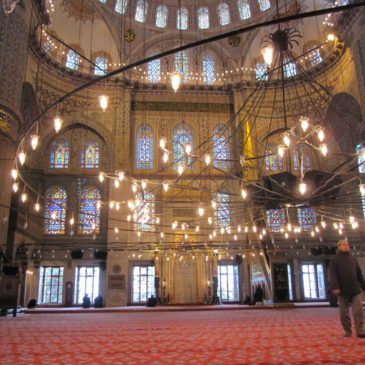
Muslims arrive for noon prayers at the Blue Mosque
No trip to Turkey would be complete without a reverential visit to the Blue Mosque. My colleague and I shook off a rug salesman and wandered in around 11:30, shortly before noon prayers (which didn’t begin until 12:30). We sat respectfully observing the smattering of adherents arriving early. I found it interesting that I couldn’t find a bathing area which is certainly part of the purification process for Muslims. (It may have been there, I just never saw it). Also interesting that Muslim woman can visit the mosque as visitors but are unwelcome for prayers.
If one makes it to the Blue Mosque it is a couple hundred yards to the Aya Sofia, a Byzantine cathedral turned into a mosque after the Ottomans conquered the area. The amazing thing to consider is how tall that dome is and how old the building is (originally build in 360 AD). Both of these locations are just a stop or two from the Grand Bazaar, opened in the 1400 as a way for the Sultan to stimulate the economy after war scattered the masses and there was great need to reestablish the city.
Istanbul is worth a visit, just be prepared for a 5 AM wake-up call from the Imam at the local mosque.
(I’ve posted several pictures on my Flickr page – www.travelswithme.com)
March 6, 2010
Tags: Czech Republic, flying buttresses, King Weceslas, Prague, St. Vitus Cathedral
Confession: I love flying buttresses.

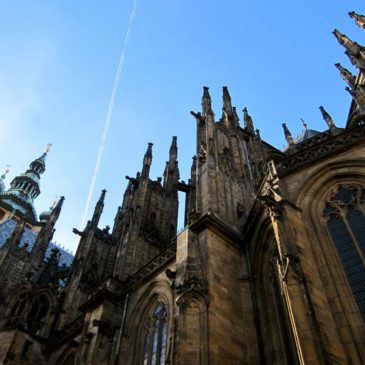
The flying buttresses of St. Vitus Cathedral, Prague, Czech Republic
It’s true, I really do and I had a close encounter with the buttresses of St. Vitus Cathedral in Prague, Czech Republic this week. I laid my hand to one and channeled the builders 800 years ago who put the blocks in place. (Okay, that part’s not true but I did touch it and think about 800 years of history since the cathedral was built).
I rarely pass an opportunity to go inside a cathedral simply because the architecture is incredible. Think about a builder’s desire to makes a statement about the bigness of God and the smallness of man. To do that technology had to be invented to support immense stone roofs and tall walls. Enter flying buttresses, enabling St. Vitus Cathedral to become the centerpiece of Prague Castle for 800 years. (Couple of pictures here, and more of Prague on my Flickr page).
The tragedy of this awe-inspiring building is that it is now only a monument to an era in Czech history when thoughts of God dominated the culture. Old Town Prague is pristine, virtually as it was when constructed in the 1200s and 1300s. Impressive churches anchor key locations, but are unfortunately now known as concert halls, museums and architectural heritage sites. The people of Prague have little interest in spiritual things, having turned their collective backs on the Catholic church and are generally closed to spiritual conversations of any kind.

Good King Wenceslas riding his dead horse. Sculpture hangs in a 100-year old mall in Prague.
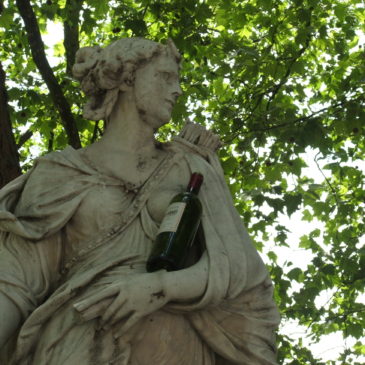
There is a very strange statue of “Good King Wenceslas” riding his dead, upside-down horse. The symbolism is open to interpretation and apparently means many things to many people. One of the better interpretations I heard was that it was a Czech’s perspective on the rule of authority. Given that there is a large metronome on one of the taller hills overlooking the city where there was once a large statue of Stalin – as if to say time marches on and this too shall pass – the view of authority figures may be quite low.
The Czech Republic is steeped in history and Prague a cosmopolitan city. the country is a member of the European Union and home to a burgeoning tech industry. Possibly the place where old and new converge most is the way Czechs embrace beer. A strong argument could be made that Czechs invented beer but at the least they’ve certainly perfected the art of drinking it. Czechs consume more beer as a people than any other people group on earth.
Czechs are a proud people with a long history who made significant contributions to Western Thought and Culture. There is much worth seeing, and much of it for free….like the flying buttresses of St. Vitus and the dead horse of the Good King.
November 18, 2009
There are many reasons to dislike American Airlines. Being dumped in Brussels, Belgium is not one of them.
I was part of a team last year that went to Uganda. American ran behind schedule from the time we left Nashville, enough that we missed our connection in Belgium. As a result we had an all-expense paid inconvenience in a pretty cool place. Since it was an overnight flight we arrived in the morning so my strategy is to always stay up until it is time to go to bed local time. So, several of us dropped our luggage and headed into the city center. Below are some images from that trip. I recommend Belgian waffles covered with Belgian chocolate. They are all they are cracked up to be.
(One caveat to these images….I took them while walking around by myself. It is still in question as to whether I got separated from the other four people I was with or if I was ditched by my four “friends.” I’m not pointing any fingers, but…)


September 26, 2009
We are hours away from leaving the US and traveling again. However a couple weeks ago my in-laws visited and we took them to one of our favorite spots for a day trip: Monticello, the home of Thomas Jefferson. Near Jefferson’s house is an apple orchard (Carter Mountain) poised on a hilltop overlooking Charlottesville. Here are some pics from the trip.

Check the back of an older nickel. The architecture and thought of this house is way ahead of its time.

God did make 'em, and He made these on Carter Mountain.

This barn is on the property where we did orientation. I'd walk out the back gate each morning as the sun came up. Great way to start a day.