Travels With Me

Archive for March, 2010

Brits,Life in UK

March 31, 2010

More reasons why I’m quite keen toward Brits (part 2)

Tags: , , , , , , , ,

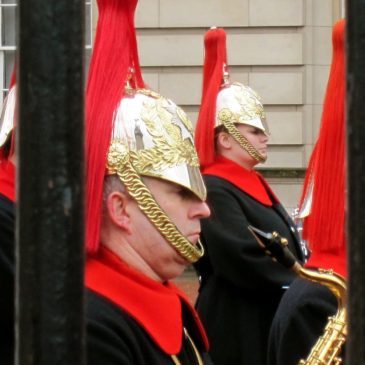
All eyes were directed toward the other end of the parade ground in front of Buckingham Palace watching two of the Queen’s Guard moving through the ceremony to change the posted guards. They were dressed impeccably smart in ceremonial uniforms carrying on a tradition that has extended hundreds of years.

A sax player in the Queen's Guard procession.

There are horses, flags, guns, marching bands, big fuzzy black hats and swords. It is the pinnacle of pomp and pageantry.

However, I was looking the other direction, watching the french horn player twist his instrument in circles working the spittle through the piping and out the bell. Not so much the pinnacle of pomp and pageantry – but a necessity if you don’t want your french horn to sound like it is gargling with salt water.

I’ve written previously on some reasons why I’m quite keen toward Brits and now add to the list.

1. Pomp and pageantry. I can’t think of a circumstance in which Brits might not seize the opportunity to add a significant amount of pomp…and I love it! I love ceremony, procession, pomp, formality and marching bands that play marching songs (think John Phillip Souza). Brits are pompous (often times in both senses of the word!). I don’t know that I know Brits well enough to say that to be British is to be inclined toward pomp, but I don’t know that it would be far off. Ceremony in regard to tradition is deeply ingrained in this culture, and it ought to be celebrated. It is one thing that makes Brits distinctly British.

Colors over British Parliment

This is an exceptional people who have done much in 1,000 years. Frankly, I am a bit perturbed at Brits who seem so quick to criticize their heritage and hand it over to multiculturalism in the name of tolerance. I see it happening in my own country (USA). It is the ceremonial parade of tradition that might just serve as a reminder to those who undermine their own country of the greatness Britain was and help some regain a respect for their culture.

2. The monuments. I’ve now made about five trips past Buckingham Palace, Trafalgar Square, 10 Downing Street, Parliament and Westminster Abbey. It all seems surreal being here and seeing it all but as I’ve continued to learn more about British history the more I appreciate the buildings and monuments that stand as a testimony to great architects (like Christopher Wren), great heroes (like Admiral Lord Nelson and his decisive victory at Trafalgar) and great statesman (like Winston Churchill). The monuments are grand, and formal and imposing and do justice to the people for whom they honor.

3. The city is photogenic. Okay, this one isn’t so much about Brits as London, but let’s face it, London has got to be one of the coolest – if not the coolest – city on earth. Because of the ubiquitousness of monuments, historical sites, great architecture and famous places, there is never ending fodder at which to point a camera. So, in that spirit, here are a few photos from the day.

Trafalgar Square down Whitehall to Big Ben.

Barcelona futbol fans descend on Piccadilly Circus.

Yours truly reflected in the ceremonial breatplate of a calvary officer on display at the calvary museum.

Islam,Istanbul,Travel photos

March 28, 2010

My introduction to Istanbul

Tags: , , , , , , , ,

Minarets rise above the Blue Mosque in Istanbul.

Minarets rise above Istanbul’s cityscape like rockets poised for a moon launch. I scanned the horizon from the narrow observation deck of Galata Tower and saw dozens of the more than 2,700 active mosques scattered across the city of more than 13 million people. I wondered where the one was that is located near the guest house where I stayed. Just the day before the 5 am call to prayer jolted me from my sleep with the equivalent shock someone might experience from sticking their finger into a 220v electrical outlet. I went from sweet dreams to 500 heart beats per second before I could open my eyes. (Interesting how by week’s end I slept right through it.)

Istanbul boasts an incredible history with a recent archeological find dating back to around 6700 BC. It’s most notable history probably began with Constantine’s successful capture of the city from the Byzantines, renaming it Constantinopolis, making it the eastern capital of the Roman Empire. However, there was a dramatic shift when Sultan Mehmed II spent 53 days securing the city for the Ottomans and dramatically changed Constantinople into a Muslim city. It has remained so for more than 600 years.

I confess to a general ignorance about Istanbul prior to my trip, like I did not know it is literally where west becomes east and east becomes west. Europe ends at the Bosphorus, a water passage that divides Istanbul. Asia begins just a short distance on the other side.

I knew Istanbul was a cosmopolitan city where orthodox Islam gives way to a more secularized religion. There are many devout Muslims in Istanbul, but there is a disproportionately larger number who seem to greet the call to prayer with staggering indifference. However, orthodoxy seems on the rise with the increased migration of people from the more conservative interior of the country. The ruling party is conservative – every member of the ruling party has wives who cover according to Islamic law – reflecting the majority opinion of Turkey’s population outside of Istanbul.

Muslims arrive for noon prayers at the Blue Mosque

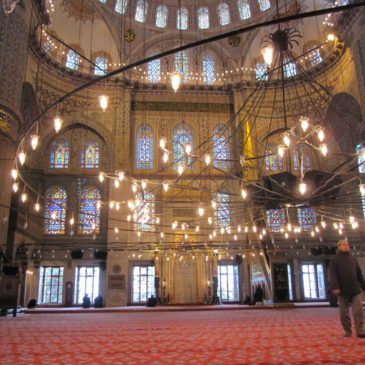
No trip to Turkey would be complete without a reverential visit to the Blue Mosque. My colleague and I shook off a rug salesman and wandered in around 11:30, shortly before noon prayers (which didn’t begin until 12:30). We sat respectfully observing the smattering of adherents arriving early. I found it interesting that I couldn’t find a bathing area which is certainly part of the purification process for Muslims. (It may have been there, I just never saw it). Also interesting that Muslim woman can visit the mosque as visitors but are unwelcome for prayers.

If one makes it to the Blue Mosque it is a couple hundred yards to the Aya Sofia, a Byzantine cathedral turned into a mosque after the Ottomans conquered the area. The amazing thing to consider is how tall that dome is and how old the building is (originally build in 360 AD). Both of these locations are just a stop or two from the Grand Bazaar, opened in the 1400 as a way for the Sultan to stimulate the economy after war scattered the masses and there was great need to reestablish the city.

Istanbul is worth a visit, just be prepared for a 5 AM wake-up call from the Imam at the local mosque.

(I’ve posted several pictures on my Flickr page – www.travelswithme.com)

Catholicism,Current issues,Evangelism

March 18, 2010

Jesus is NOT America’s Chief Patriot

Tags: , , , , ,

In June, 2006 I desperately needed a friend of mine to help me keep my mouth shut.

We’d just arrived in town for a major annual religious convention and were awaiting our turn at the hotel’s reception desk when I noticed the t-shirt of the pastor in front of me. It was a red, white and blue ichthus (fish symbol) with the words JesUSAves underneath. My friend saw my temperature rising and wasn’t sure whether to prod me to the point of explosion or stage an intervention and save this unsuspecting Patriotic Pastor from a torrent of “righteous indignation.” Fortunately he chose the latter, allowing the pastor to cluelessly bound on his jolly way while probably saving me from job termination.

The pastor’s transgression? His  (as well as many prominent people in my denomination and evangelicals across America) elevation of Jesus Christ to position as Chief  Patriot of the United States – a significant demotion from His position as “the image of the invisible God, the firstborn of all creation.”

I’d forgotten about that encounter until last night when it was dragged from my subconscious while watching the movie Luther. There is a scene in the movie when a former professor and zealous supporter of Martin Luther’s, Andreas Karlstadt, is portrayed as a driving force behind the Peasant Wars of 1524-25* (see note at bottom). Supposedly Karlstadt launches a crusade to purge the church of icons and images of any kind, waging holy war against priests and any other formal church representative. In the movie he says, “Stand with the righteous or be cut down, with the others. There is no middle ground!”

The movie is fundamentally correct, despite some minor historical gymnastics. Luther, a former Catholic priest, came to see the church’s practice of indulgences as hypocrisy, he preached against salvation through the church and for salvation through faith in Christ alone. It sparked what we now call the Reformation.

The movie and the Patriotic Pastor intersect at the point where Christians seek to build Christ’s Kingdom in any manner other than the proclamation of the Gospel. Truth is we’ve been trying for centuries to establish God’s Kingdom through our misdirected theology. The crusades were an attempt to do God a favor and drive “infidel Turks” from Jerusalem, re-establishing the city as “the City of God.” The burning of witches at Salem was an attempt to purge the culture of godless influences and maintain a “Christian nation.”

Truth is, America has never been a Christian nation – and most certainly is not now. America was a nation shaped by biblical ideas and by men who were influenced by Scripture – several of whom were followers of Christ but many others who were deists. In fact, four of our most influential American “fathers” – Washington, Franklin, Jefferson and James Madison (“Father of the Constitution”) – believed in a Supreme Being proven by human reason with no need of faith. Our country has been a moral nation influenced by biblical precepts but there is a massive difference between morality and Christianity.

Too many high profile Christian leaders today (and many a good Patriotic Pastor) push and leverage  for change through imposing biblical principle on society through attempts to legislate morality. I find it laughable and an utter waste of effort/money. God Himself established the Ten Commandments – moral law – knowing in advance that the hearts of men are not changed through the keeping of law. At best the law keeps immorality in check and does NOTHING to establish the reign and rule of Christ’s Kingdom in the hearts of mankind by liberating sinners from the tyranny of morality through the external righteousness imputed to us through a sinless Savior.**

Moreover, our pastors and leaders too often stand in pulpits and pour out their moralistic tomes on sinners – as if pointing out their sins does anything more than drive the nails into dead men’s coffins. They seemingly say, “Stand with the righteous or be cut down, with the others. There is no middle ground!” How is that helpful? Dead men are dead already. Instead of preaching liberation through forgiveness found in the Good News that Jesus died in their place to pay the penalty for their sin if they will believe in Him, the objective too often appears to be reclaiming some fallacious idea of a Christian nation by shaping our nation’s laws to make sinner’s adhere to biblical law.

The evangelical church in America will never find its bearings if its pastors and leaders don’t revisit Scripture passages like John 18:33-38 and repent of trying to usher in Christ’s Kingdom through political, legislative or by any other means.

Jesus is NOT America’s Chief Patriot. He is the Savior of the World.

*This is an inaccuracy in the movie and Karlstadt was not the instigator in real life he is portrayed to be in the movie. His teachings were much more civil and in fact was given refuge by Luther during the Peasant Wars.

**I firmly acknowledge that Christians should fight evil in the world by every means possible but we spend more time using the courts rather than the tools described in Ephesians 6.

Life in UK

March 14, 2010

“…And I live in a small town”

Tags: , , ,

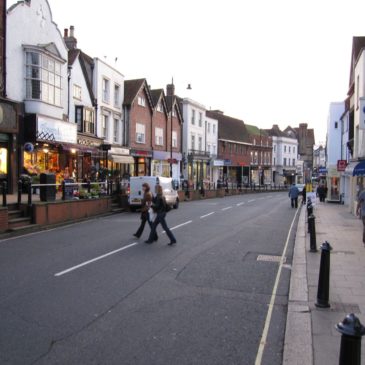
I love Dorking, the town near where I live. It is a little more than a mile from our house so will often walk “to town” on Saturday’s. Stops include Millet’s (an outdoor equipment store), Oxfam (a used bookstore), British Bookshops, a really cool mom and pop hardware store and Starbucks.
Last week I read a brief history of Dorking and learned it has probably existed since at least 40 AD. It was a stop on the Roman road from a city on the southern coast of England to London. Dorking once had a reputation as a smugglers’ town (with a maze of tunnels that still run beneath the city streets).
A local resident sailed on the Mayflower, John Wesley started a church here and a host of other famous people have passed through a town that has changed little in its complexion in probably 200 years.

Dorking's St. Martin's church

Through the years Dorking grew in prominent residents who established large farms and neighbors tell me Denbies Vineyard produces the UK’s best wine.

I don’t believe that I’ve ever walked through Dorking without the words of John Mellencamp’s song “Small Town” echoing through my mind. (So, here’s my video dedication to my adopted town.)

Czech Republic,Travel photos

March 6, 2010

Of flying buttresses and dead horses

Tags: , , , ,

Confession: I love flying buttresses.

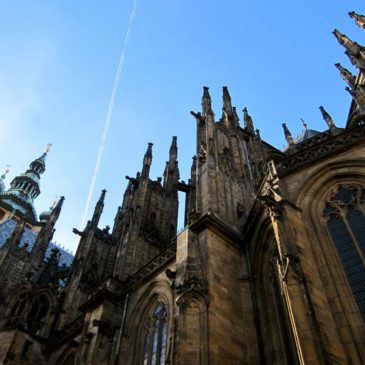
The flying buttresses of St. Vitus Cathedral, Prague, Czech Republic

It’s true, I really do and I had a close encounter with the buttresses of St. Vitus Cathedral in Prague, Czech Republic this week. I laid my hand to one and channeled the builders 800 years ago who put the blocks in place. (Okay, that part’s not true but I did touch it and think about 800 years of history since the cathedral was built).

I rarely pass an opportunity to go inside a cathedral simply because the architecture is incredible. Think about a builder’s desire to makes a statement about the bigness of God and the smallness of man. To do that technology had to be invented to support immense stone roofs and tall walls. Enter flying buttresses, enabling St. Vitus Cathedral to become the centerpiece of Prague Castle for 800 years. (Couple of pictures here, and more of Prague on my Flickr page).

The tragedy of this awe-inspiring building is that it is now only a monument to an era in Czech history when thoughts of God dominated the culture. Old Town Prague is pristine, virtually as it was when constructed in the 1200s and 1300s. Impressive churches anchor key locations, but are unfortunately now known as concert halls, museums and architectural heritage sites. The people of Prague have little interest in spiritual things, having turned their collective backs on the Catholic church and are generally closed to spiritual conversations of any kind.

Good King Wenceslas riding his dead horse. Sculpture hangs in a 100-year old mall in Prague.

There is a very strange statue of “Good King Wenceslas” riding his dead, upside-down horse. The symbolism is open to interpretation and apparently means many things to many people. One of the better interpretations I heard was that it was a Czech’s perspective on the rule of authority. Given that there is a large metronome on one of the taller hills overlooking the city where there was once a large statue of Stalin – as if to say time marches on and this too shall pass – the view of authority figures may be quite low.

The Czech Republic is steeped in history and Prague a cosmopolitan city. the country is a member of the European Union and home to a burgeoning tech industry. Possibly the place where old and new converge most is the way Czechs embrace beer. A strong argument could be made that Czechs invented beer but at the least they’ve certainly perfected the art of drinking it. Czechs consume more beer as a people than any other people group on earth.

Czechs are a proud people with a long history who made significant contributions to Western Thought and Culture. There is much worth seeing, and much of it for free….like the flying buttresses of St. Vitus and the dead horse of the Good King.