Travels With Me

Posts Tagged ‘Jesus’

Jerusalem,Middle East

October 20, 2010

Jerusalem: The (un)Holy City

Tags: , , , , , , , ,

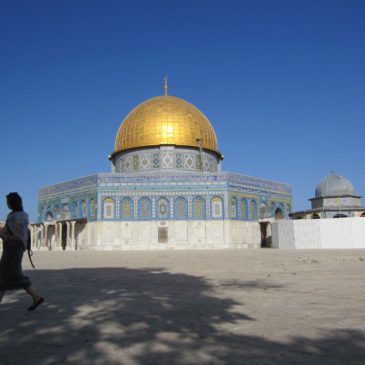
The Dome of the Rock is an Islamic shrine and major landmark located on the Temple Mount in Jerusalem. It was completed in 691-692, making it the oldest existing Islamic building in the world. The site's significance stems from the religious beliefs regarding the rock, known as the Foundation Stone, at its heart.

There is something ironic about Old City Jerusalem being called, “The Holy City.” It isn’t.

Jerusalem is a city where stress runs high and the strain of so many people practicing so many religions in such a small area makes the tension palatable. Young Muslim men spitefully mock an elderly Jewish man as he winds his way through the Muslim quarter on his way to morning prayers. Devout Jews press their faces against the Western Wall, crying out to God to hear their prayers while harboring contempt in their hearts toward Muslims whose Dome of the Rock located on the other side of the wall is anathema (it is built on the site where the Jewish temple once stood thousands of years ago). People of traditional religions press their icons and rosaries against the slab of rock within the Church of the Holy Sepulchre believed to be the stone upon which Jesus was laid after being crucified. Tears streaming down their faces, they seek a blessing or a healing or some connection with God through well meaning, but mistaken, devotion.

The Western Wall is located in the Old City of Jerusalem at the foot of the western side of the Temple Mount. It is a remnant of the ancient wall that surrounded the Jewish Temple and is one of the most sacred sites in Judaism.

Bitter schism resides just below the surface and there isn’t any one of these factions that would be disappointed if the other two would exit the city walls. Money is the unifying denominator. Remove the tourist dollar – take away the thousands of global residents who push their way through the throng along the cobblestone streets leaving a significant amount of money with the hundreds of gift shops – and it would boil over.

My task during my eight days of wandering through the Jerusalem maze was to find out what Jerusalem means to the people who live there. Through several interviews and probing questions it quickly became obvious that the romantic notions people I know have of Jerusalem are not shared by the people who live within Old City’s walls. As objective as inhabitants say they are or try to be it all goes pear shaped with one question: What do you think it will take for there to be peace in Jerusalem?

Palestinian Muslims clamor for Jewish building and resettlement to cease in the West Bank and for Jews to reinstate boundary lines as they were in 1948 or 1967. Then, they say, there will be peace. Jews wail at the Western Wall over the defilement they believe the Muslim’s mosque and monument bring to the Temple Mount. Remove the Dome and Mosque and then, they say, there will be peace. Both groups harbor contempt toward “Christians” (the word they associate with those practicing Catholic and Orthodox traditions) for the Crusades and mock them for their idol worship.

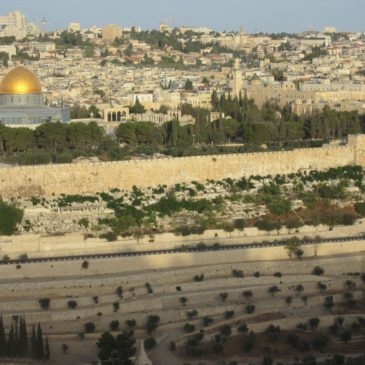
Looking into the Eastern side of Jerusalem from the Mount of Olives, a view very similar to what Jesus might have had.

I recognize these are generalizations and not everyone in Jerusalem feels this way, but I talked with enough people in each group to get a sense that a significant number of people in Jerusalem believe the most lasting solution for peace rests upon the total expulsion or annihilation of his or her neighbor. As one devout Jew said, “There will never be peace as long as that dome sits on the Temple site.”

The Bible records Jesus approaching Jerusalem from the Mount of Olives and looking across the narrow valley and into the city. The temple would have been plainly visible to Him since its location sat near the wall on that eastern side. His perspective was slightly elevated from the hillside so He was looking down into Jerusalem. “Jesus looked over the city and wept,” Luke wrote of the occasion.

Why was Jesus weeping? Wasn’t Jerusalem a holy city? It was not. It was a religious city – much as it is today – and that is why he wept. The religious leaders of the day brought such bondage on the people that there was no joy in serving and worshiping God. They were so busy ritual keeping that they failed to rightly interpret Scripture and recognize Christ as the fulfillment of thousands of years of prophecy. Jesus wept precisely because there was no holiness, only ritual.

In the Church of the Holy Sepulchre, a devout Catholic, rosary in hand, kisses the stone slab upon which it is believed that Jesus was laid after the crucifixion.

I am convinced after walking the streets myself and talking to devout and secular Jews, Muslims and “Christians” that Jesus would weep because nothing has changed. If anything I’d say it has become more complicated and contentious. The bondage of religion is heavier now than it ever has been. Reconciliation to God through the Son brings peace with God and produces holiness. Holiness before God produces peace within oneself that radiates outward to bring peace among other people. As Paul wrote, “as much as it is within you, live at peace with all men.”

Jerusalem needs your prayers. In fact the Bible commands us to pray for the peace of Jerusalem. Peace will not come through religion, mostly because religion is divisive and some of the great atrocities in the history of the world have come because of religion. Jerusalem is rife with religion.

Don’t call Jerusalem the Holy City. It is not a Holy City; it is a religious city and the difference is the difference between war and peace.

Central Asia,Devotional thoughts,Islam,Middle East,Muslim

April 4, 2010

The lamentation of Easter

Tags: , , , , , , , ,

This is what is historically known and recorded by multiple historians and writers of the day: There was a Jew named Jesus who claimed to be the Son of God (and by the claim being God Himself) and had a following of people. Eventually He was executed because of this claim of being God (blasphemy by Jewish law) and for being a trouble maker by Roman law. He died, confirmed by the strict procedures of Roman crucifixion. He was placed in a tomb guarded by both Roman and Jewish guards, three days later His tomb was empty, causing a widespread commotion in Jerusalem over his disappearance.

These facts are easily confirmed. What is also confirmed is that everyone who had a deeply vested interest in finding His body used every means necessary to find the body, including questioning and torturing those who followed Jesus. Few recanted their belief He was God, especially the many who physically saw and spoke to the resurrected Christ.

In 24 hours, I’ve read dozens of Twitter tweets, Facebook updates and blog posts about the celebration Easter is in the lives of individuals. Rightfully so, although every day is in fact Easter for the believer because nothing will ever change the historical fact that Jesus received the wrath of a Holy God – punishment intended for the sinner – and was raised from the dead, confirming God’s satisfaction with the substitutionary sacrifice. What’s left is for the individual to believe by faith that Jesus came to this world to accomplish this stated purpose.

Unfortunately Easter is also a day of lamentation because more than 2/3 of the world’s population – 4 billion-plus people – do not call Jesus Lord or know that His death and resurrection are the only sufficient means to reconcile them to God. Sadly, many of that four billion have never even heard the name of Jesus Christ. They are trapped in the endless spiritual search to generate some kind of righteousness to make them acceptable to whatever their idea of god is. This reveals the difference between religion and Christianity. Religion is a way for man to create a means for reaching God. Christianity is based solely on God reaching down to man.

It may seem subtle but there is a massive difference  between the two. Religion is easily manipulated to justify the ends of man. In religion there is no objective measure of righteousness, man becomes the center of establishing the standard and ultimately it is often left to the one who most vehemently asserts his beliefs as to whose perspective is “correct” (see long history of holy wars as evidence). Which religion, then, is right? Islam, Buddhism, Hinduism, Judaism, Catholicism, Protestantism? Answer: none.

Christianity, however, is uniquely and exclusively set over and against these in that God sets the objective measure, indicates that every human is in the same boat (“all have sinned“), and that there are “none righteous” and “none seek after God.” Therefore every human stands on equally poor footing. Into this desperate situation God sent Jesus to bear His justified wrath. Jesus was a willing and perfect object upon which God’s punishment could be poured. The resurrection is evidence that His sacrifice was acceptable. Crying out in faith to Him for salvation is recognizing our need for something beyond ourselves to save us. This is Good News!

But it is only Good News if people hear it. Right now there are more than 5,000 unengaged people groups around the world, most of them in a swath of land extending across north Africa, the Middle East, central and eastern Asia and India. This means there are a significant number of Muslims, Hindus, atheists and Buddhists who either have no understanding of Jesus or a very skewed understanding of who He is, what He’s done and what He offers in terms of spiritual forgiveness and freedom.

We who have been granted forgiveness and salvation must remember every day the extraordinary grace extended to us through Christ, but we can’t linger in our celebration lest it become self-centered. We must remember the billions of people who have not yet enjoyed His grace, lament the staggering numbers who still stand squarely in the cross-hairs of God’s judgment and GO to them with the Good News of what the resurrection means for them.

Catholicism,Current issues,Evangelism

March 18, 2010

Jesus is NOT America’s Chief Patriot

Tags: , , , , ,

In June, 2006 I desperately needed a friend of mine to help me keep my mouth shut.

We’d just arrived in town for a major annual religious convention and were awaiting our turn at the hotel’s reception desk when I noticed the t-shirt of the pastor in front of me. It was a red, white and blue ichthus (fish symbol) with the words JesUSAves underneath. My friend saw my temperature rising and wasn’t sure whether to prod me to the point of explosion or stage an intervention and save this unsuspecting Patriotic Pastor from a torrent of “righteous indignation.” Fortunately he chose the latter, allowing the pastor to cluelessly bound on his jolly way while probably saving me from job termination.

The pastor’s transgression? His  (as well as many prominent people in my denomination and evangelicals across America) elevation of Jesus Christ to position as Chief  Patriot of the United States – a significant demotion from His position as “the image of the invisible God, the firstborn of all creation.”

I’d forgotten about that encounter until last night when it was dragged from my subconscious while watching the movie Luther. There is a scene in the movie when a former professor and zealous supporter of Martin Luther’s, Andreas Karlstadt, is portrayed as a driving force behind the Peasant Wars of 1524-25* (see note at bottom). Supposedly Karlstadt launches a crusade to purge the church of icons and images of any kind, waging holy war against priests and any other formal church representative. In the movie he says, “Stand with the righteous or be cut down, with the others. There is no middle ground!”

The movie is fundamentally correct, despite some minor historical gymnastics. Luther, a former Catholic priest, came to see the church’s practice of indulgences as hypocrisy, he preached against salvation through the church and for salvation through faith in Christ alone. It sparked what we now call the Reformation.

The movie and the Patriotic Pastor intersect at the point where Christians seek to build Christ’s Kingdom in any manner other than the proclamation of the Gospel. Truth is we’ve been trying for centuries to establish God’s Kingdom through our misdirected theology. The crusades were an attempt to do God a favor and drive “infidel Turks” from Jerusalem, re-establishing the city as “the City of God.” The burning of witches at Salem was an attempt to purge the culture of godless influences and maintain a “Christian nation.”

Truth is, America has never been a Christian nation – and most certainly is not now. America was a nation shaped by biblical ideas and by men who were influenced by Scripture – several of whom were followers of Christ but many others who were deists. In fact, four of our most influential American “fathers” – Washington, Franklin, Jefferson and James Madison (“Father of the Constitution”) – believed in a Supreme Being proven by human reason with no need of faith. Our country has been a moral nation influenced by biblical precepts but there is a massive difference between morality and Christianity.

Too many high profile Christian leaders today (and many a good Patriotic Pastor) push and leverage  for change through imposing biblical principle on society through attempts to legislate morality. I find it laughable and an utter waste of effort/money. God Himself established the Ten Commandments – moral law – knowing in advance that the hearts of men are not changed through the keeping of law. At best the law keeps immorality in check and does NOTHING to establish the reign and rule of Christ’s Kingdom in the hearts of mankind by liberating sinners from the tyranny of morality through the external righteousness imputed to us through a sinless Savior.**

Moreover, our pastors and leaders too often stand in pulpits and pour out their moralistic tomes on sinners – as if pointing out their sins does anything more than drive the nails into dead men’s coffins. They seemingly say, “Stand with the righteous or be cut down, with the others. There is no middle ground!” How is that helpful? Dead men are dead already. Instead of preaching liberation through forgiveness found in the Good News that Jesus died in their place to pay the penalty for their sin if they will believe in Him, the objective too often appears to be reclaiming some fallacious idea of a Christian nation by shaping our nation’s laws to make sinner’s adhere to biblical law.

The evangelical church in America will never find its bearings if its pastors and leaders don’t revisit Scripture passages like John 18:33-38 and repent of trying to usher in Christ’s Kingdom through political, legislative or by any other means.

Jesus is NOT America’s Chief Patriot. He is the Savior of the World.

*This is an inaccuracy in the movie and Karlstadt was not the instigator in real life he is portrayed to be in the movie. His teachings were much more civil and in fact was given refuge by Luther during the Peasant Wars.

**I firmly acknowledge that Christians should fight evil in the world by every means possible but we spend more time using the courts rather than the tools described in Ephesians 6.