February 21, 2010
Tags: Canterbury, Dorking, Dover, North Downs Way, Pilgrim's Way, Rambling, White Cliffs
There isn’t a T-shirt….yet, but later this year I plan to hike from Dorking to Dover…in five days.
There, it’s out there, public for all to see and for all to heap on me humiliation if I don’t follow through. I’ve talked an impressive game, telling friends and neighbors of my plan soliciting, “oohs” and “ahhs,” and statements like, “That’s quite an ambitious plan you’ve got.”
It is ambitious. I’ll be hiking the North Downs Way that cuts across southern England from West to East, going through Canterbury and ending in Dover at the White Cliffs of Dover, overlooking the English Channel toward France. The pathway (as trails are called here) is roughly 132 miles from its beginning in Farnham to its end in Dover. It passes within a half mile of our house and from here to Dover is about 100 miles, or what would be an average of about 20 miles a day to make it in five days. I may give myself a sixth day to account for lingering in Canterbury and visiting the Cathedral.
Another name for North Downs Way is Pilgrim’s Way. The two are separate pathways but converge for most of the trip to Canterbury. The Pilgrim’s Way is the route many a devout Catholic annually took for making penance at the Cathedral. This pilgrimage was canonized in Canterbury Tales, by Geoffry Chaucer.
Walking, or “rambling” as it is called here is a serious hobby (there is a national rambling club with many local branches), so to say I’m going to make this trek immediately grabs attention and a fair amount of surprise that an American would be endeavoring something so bold that requires so much physical exertion. Even without having done it, just the fact that I’ve even considered it, garners credibility. But make no mistake, I am certain if I don’t follow through I’d have accomplished exactly what many Brits would expect of an American.

Overlooking Dorking from the North Downs Way above Denbies Orchard, near the beginning of my Dorking to Dover trek.
Brits are people of considerable resolve, especially the older generation, many of whom I usually encounter on a hillside somewhere while rambling. Remember, these are the people who had bombs raining on their major industrialized cities during WWII. They emerged from rubble realizing they were not dead and believed if that is the best the Germans could offer then it will be virtually impossible to be defeated. They pulled themselves together and determined to carry on. Most Brits don’t grumble much so to milk the great Dorking to Dover ramble of as much pre-ramble drama as possible could potentially backfire.
So, last night with map spread on the table, highlighter in hand and Web browser open looking for places to bed down each night, I launched into the initial stages of actually planning my adventure. There is equipment to buy, meals to plan and boots to break in. Of course the accomplishment won’t be complete until there is a T-shirt: “Dorking to Dover 2010: the ramble of all rambles.”
February 19, 2010
Tags: Golf, PGA, press conference, Tiger Woods
Was it staged? Was it genuine? Did he do enough? Did he do too much? Is he sorry or is he scrambling for his professional life? One thing’s for sure, people and the press will pick apart every word Tiger Woods said today as he stood before the world to give an accounting of his adulterous lifestyle.
I am amazed at the hypocrisy of the people who stand in judgment of Tiger – which is everyone who has felt superior to him based on some sense of personal moral righteousness. (I touched on this in my previous post about Tiger Woods and Christmas). I do not condone Tiger’s actions; what he did is inexcusable. But I wonder how the rest of us would have handled the skill, money, power, and access to so many willing accomplices. In one regard the rest of us have the great luxery of never knowing the same pressures because there is only one person in the world in such a unique position: Tiger. The irony is that the rest of us fail in so many other ways, falling just as far short of the expectations God has for us and nobody bats and eye lash. We say, “Well I have my warts, but at least I’m not as bad as Tiger.” Actually, you are a lot worse than you think. Romans 3:23 says “all have sinned and fallen short of God’s glory.” Even a single “little” sin makes us a gigantic spiritual failure in the eyes of God.
With so many people picking up stones it is worth a reminder that Jesus said “He who is without sin can cast the first stone.” Tiger has to live with himself and the consequences of what he’s done and doubtful anyone will be as hard on Tiger as he will be on himself. Unfortunately, all the therapy in the world isn’t going to remove his fundamental problem. Only repentance found in Jesus, believing He is the perfect substitute to receive punishment due us will free Tiger – and anyone else – from the bondage of sinful hearts.
February 6, 2010
Tags: Catholic, Chile, gospel, theology
Update: I posted several photos from Chile to my flickr site.
Several years ago I told a friend of mine my wife and I were moving to Panama. “Panama?” he asked as if it had recently been discovered. I waited for something profound to follow, like a question about the canal or the political ramifications of decades of military dictatorships that blackened the eye of a nation’s people. I got neither.
“They have Mexican food down there?”
I love Latin America. We North Americans too quickly dismiss our neighbors to the south and the millions with whom we share the Western hemisphere. Frankly we generally ignore more than a doz
en Spanish-speaking countries or at best think they are all Mexicans or that Mexican culture is the culture shared by all Central and South Americans. Nothing could be more inaccurate. There is a distinct personality to every country to our south. (A great resource for understanding Latin America is The Epic of Latin America, by John Crow).
Despite the diversity among the countries there are several commonalities Latin Americans obviously share. One of those is what I consider to be an unhealthy obsession with the Virgin Mary.
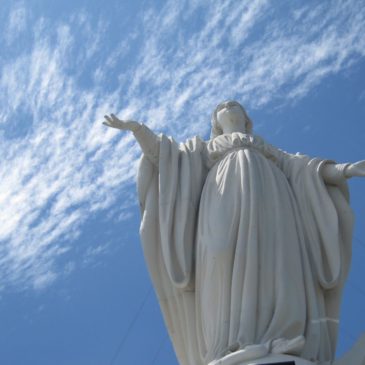
I’ve traveled extensively in Latin America so have seen various expressions of veneration. I’ve been in Santiago de Chile this week and visited “La Virgincita” – literally translated: “The Little Virgin” (which just happens to be about 40 tall, sits atop a hill and can be seen from across the city, even at night because she is illuminated). One of the prayers fastened to the wall at the statue’s base sums up how most Latin American Catholics would view Mary: as an intercessor between man and Jesus (the picture is of that prayer).
It is heart rending to witness the depth of idol worship among Latin Catholics. They virtually see Mary as the female expression of God. She most often is elevated above Christ (and is literally in Santiago where a much smaller statue of a crucified Christ stands in a subordinate position on the hill beneath Mary). To our shame, too many evangelicals – including some missiologists – lump too many Latin Catholics into the “evangelized” category because of the “Christian” venire stretched across what truthfully is a pagan religion. The word “Evangelism” means “Good news,” news that God came to earth to save sinful men from His impending – and deserved – judgment. Our good news is found in the person and work of the God-man Jesus Christ, NOT the human agent God the Father appointed to birth God the Son into this world. Mary is not an intercessor between man and Jesus. Jesus is the intercessor between man and God.
I recognize my position would be the bane of many Catholics and even some evangelicals who propagate the idea that because Catholics have access to the Bible they are evangelized. I also recognize my thoughts portray a narrow-minded perspective among all “tolerant” people as being a conservative’s rant. But what must be stated is that this has nothing to do with conservative vs. liberal, protestant vs. Catholic or any other man-made pitting of one position over against another. My response to all challengers is simply this: What does the Bible say?
Catholicism (as well as way too much protestant and evangelical theology these days) posits a works-based theology. However, justification of one’s soul is found outside of oneself, at the cross where Jesus bore the wrath of a holy God to cancel the debt owed by sinful man. This same inaccurate theology finds righteousness in “good works” and misses the clear biblical point that even righteousness is transferred (imputed) from Christ to us. Unfortunately Catholic theology goes so far as to teach that justification of the soul is a continuous process and not a single pronouncement by God of forgiveness of sin. Justification and sanctification are seen as one in the same. The Catholic lives his or her life seeking to earn sanctification through works instead of living in the freedom extended through faith in Christ alone. (I do acknowledge there are Catholics who believe by faith in Christ.)
It is unfortunate that the religion propagated by Spanish conquistadors has held Latin American peoples in theological bondage for 500 years. Pray that the similarity among these diverse people is not found In the misperception that they are all Mexican, but that they will all be liberated by the Gospel.